pttools.bubble.boundary
Functions for calculating the properties of the bubble boundaries
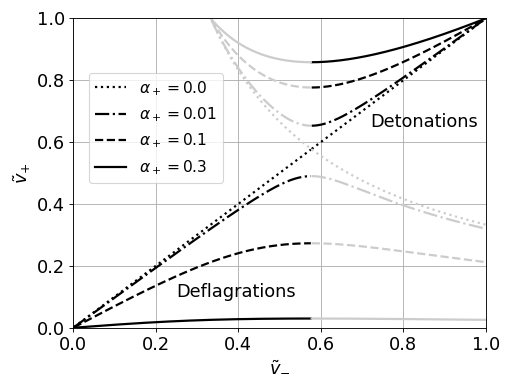
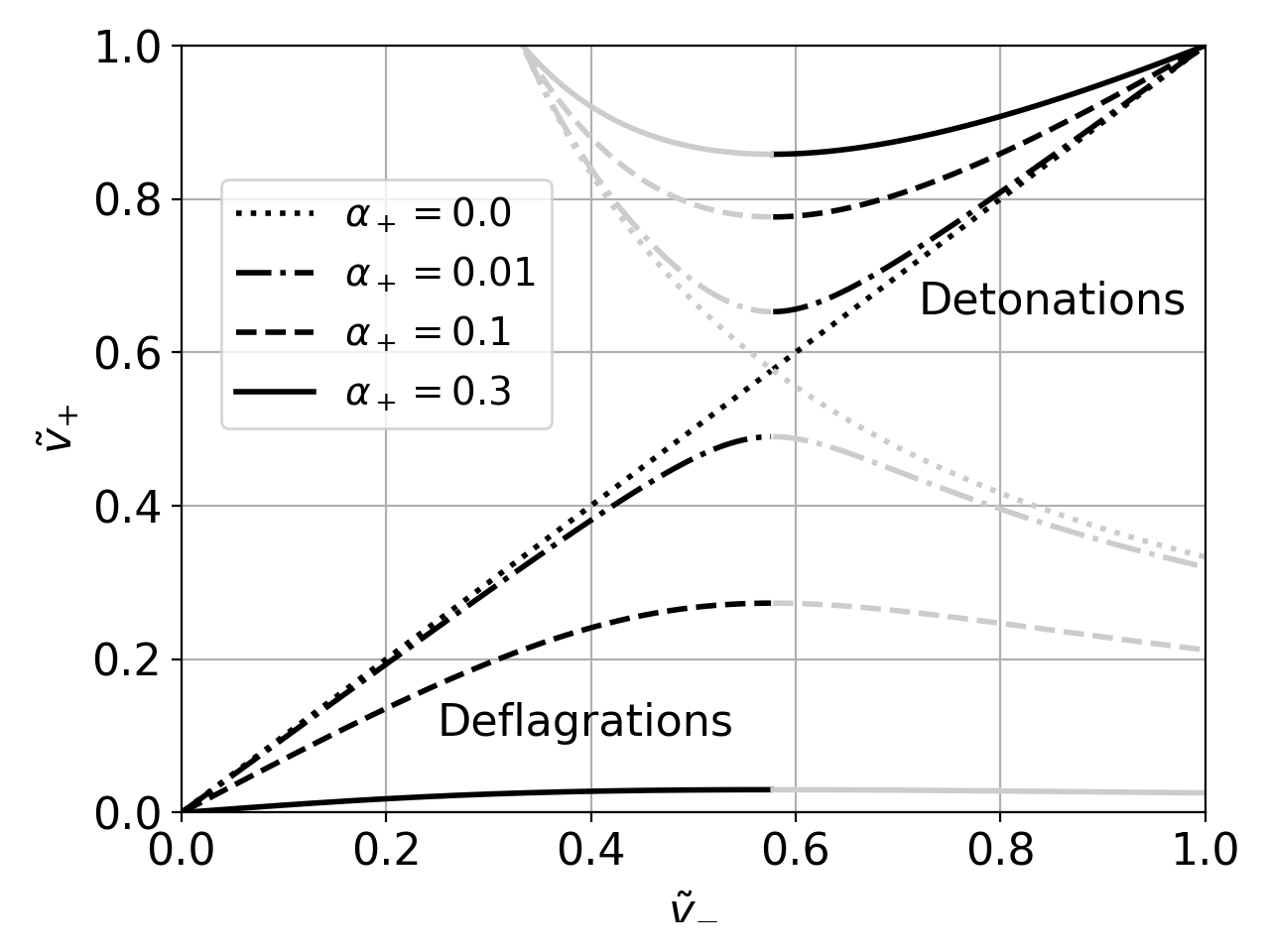
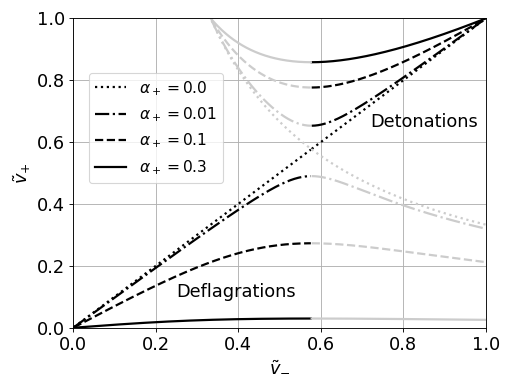
(Source code, png, hires.png, pdf)
Classes
- class pttools.bubble.boundary.Phase(value, names=_not_given, *values, module=None, qualname=None, type=None, start=1, boundary=None)
Bases:
float,EnumIn general the phase is a scalar variable (a real number), and therefore also these values are floats.
- BROKEN = 1.0
- SYMMETRIC = 0.0
- class pttools.bubble.boundary.SolutionType(value, names=_not_given, *values, module=None, qualname=None, type=None, start=1, boundary=None)
Bases:
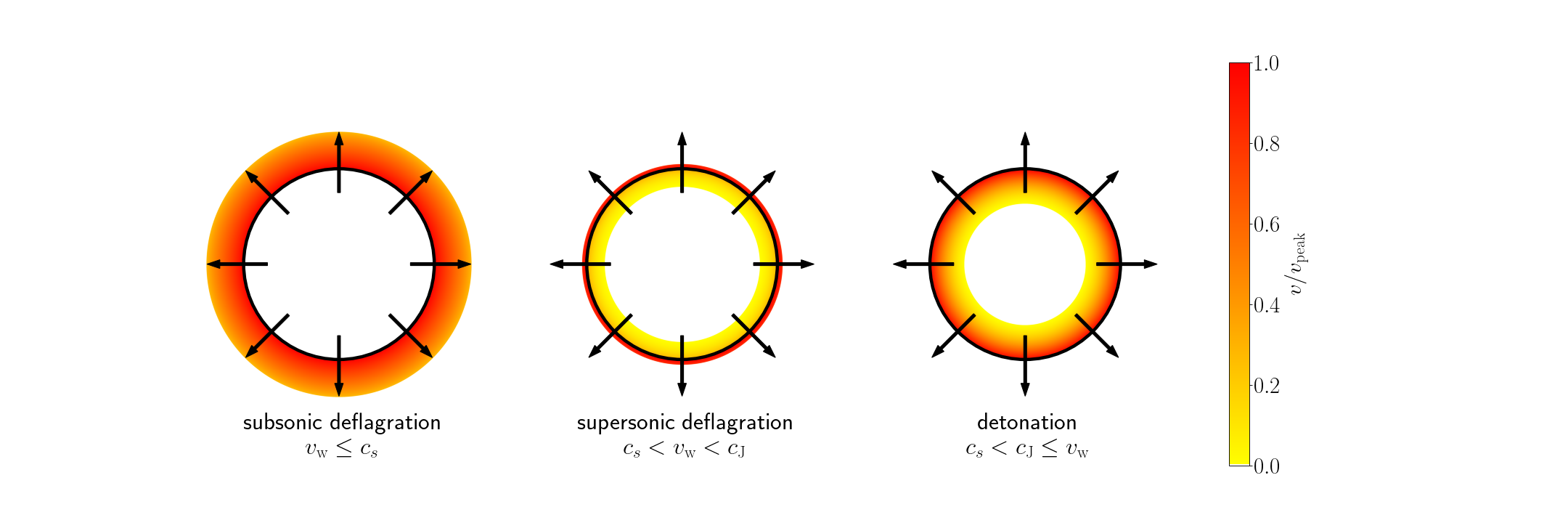
str,EnumThere are three different types of relativistic combustion. For further details, please see chapter 7.2 and figure 14 of Hindmarsh et al., 2021.
(
Source code,png,hires.png,pdf)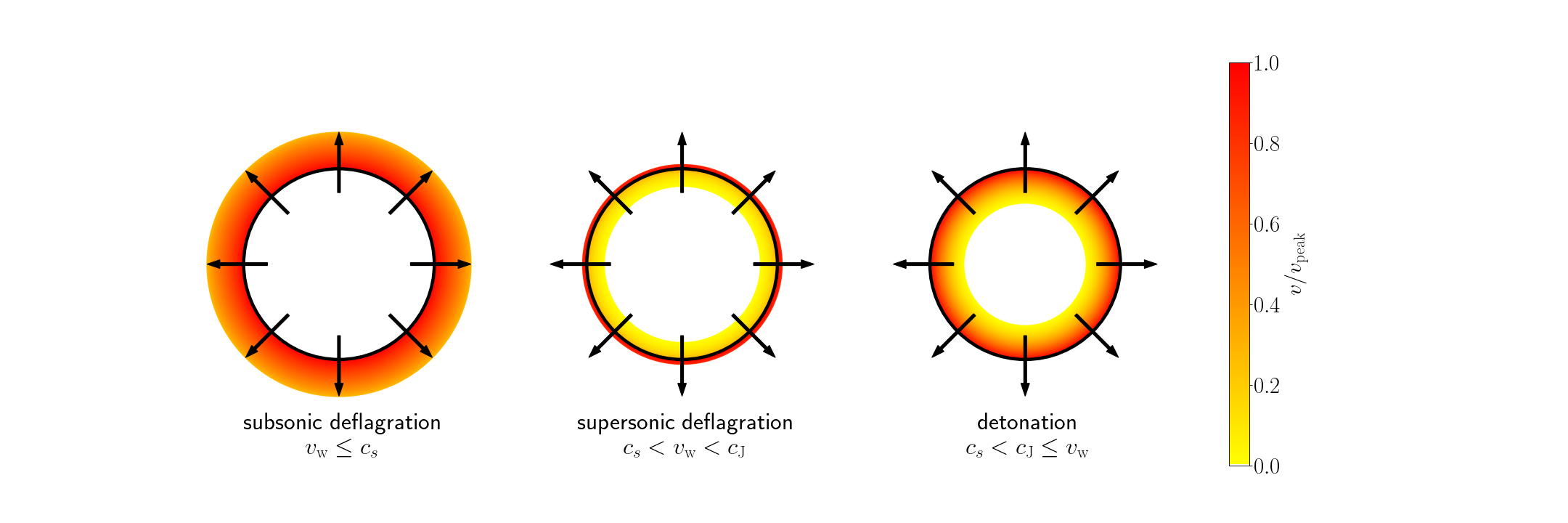
- DETON = 'Detonation'
In a detonation the fluid outside the bubble is at rest and the wall moves at a supersonic speed.
- ERROR = 'Error'
This value is used to inform, that determining the type of the relativistic combustion failed.
- HYBRID = 'Hybrid'
In the hybrid case the wall speed is supersonic and the fluid is moving both ahead and behind the wall.
- SUB_DEF = 'Subsonic deflagration'
In a subsonic deflagration the fluid is at rest inside the bubble, and the wall moves at a subsonic speed.
- UNKNOWN = 'Unknown'
This value is used, when the type of the relativistic combustion is not yet determined.
Functions
- pttools.bubble.boundary.check_entropy_fluxes(model, v1_tilde, v2_tilde, w1, w2, phase1, phase2, allow_negative_entropy_flux_change=False)
False = OK, True = fail
- pttools.bubble.boundary.enthalpy_ratio(v_m, v_p)
Ratio of enthalpies behind (\(w_-\)) and ahead \((w_+)\) of a shock or transition front, \(w_-/w_+\). Uses conservation of momentum in moving frame.
\[\frac{\gamma^2 (v_m) v_m}{\gamma^2 (v_p) v_p}\]
- pttools.bubble.boundary.entropy_flux(v_tilde, s)
- pttools.bubble.boundary.fluid_speeds_at_wall(v_wall, alpha_p, sol_type)
Solves fluid speed boundary conditions at the wall to obtain the fluid speeds both in the universe (plasma frame): \(v_+\) and \(v_+\) and in the wall frame: \(\tilde{v}_+, \tilde{v}_-\).
Bag model only!
The abbreviations are: fluid speed (vf) just behind (m=minus) and just ahead (p=plus) of wall, in wall (_w) and plasma/universe (_p) frames.
TODO: add a validity check for v_minus
- Parameters:
v_wall (float) – \(v_\text{wall}\)
alpha_p (float | float64 | ndarray) – \(\alpha_+\)
sol_type (SolutionType) – solution type
- Returns:
\(\tilde{v}_+,\tilde{v}_-,v_+,v_-\)
- Return type:
Tuple[float, float, float, float]
- pttools.bubble.boundary.get_phase(xi, v_w)
Returns array indicating phase of system. in symmetric phase \((\xi > v_w)\), phase = 0 in broken phase \((\xi < v_w)\), phase = 1
- pttools.bubble.boundary.junction_condition_deviation1(v1, w1, v2, w2)
Deviation from the first junction condition
\[w_- \tilde{\gamma}_-^2 \tilde{v}_- - w_+ \tilde{\gamma}_-^2 \tilde{v}_+\]Hindmarsh et al., 2021, eq. 7.22
- pttools.bubble.boundary.junction_condition_deviation2(v1, w1, p1, v2, w2, p2)
Deviation from the second junction condition
\[w_1 \tilde{\gamma}_1^2 \tilde{v}_1^2 + p_1 - w_2 \tilde{\gamma}_2^2 \tilde{v}_2^2 - p_2\]Hindmarsh et al., 2021, eq. 7.22
- pttools.bubble.boundary.junction_conditions_deviation(vp, vm, ap)
Deviation from the combined junction conditions
\[\Delta = \left( \frac{1}{\tilde{v}_-} + 3\tilde{v}_- \right) \tilde{v}_+ - 3(1 + \alpha_+) \tilde{v}_+^2 - \alpha_+ + 1\]
- pttools.bubble.boundary.junction_conditions_solvable(params, model, v1, w1, phase1, phase2)
Get the deviation from both boundary conditions simultaneously.
- pttools.bubble.boundary.solve_junction(model, v1_tilde, w1, phase1, phase2, v2_tilde_guess, w2_guess, v2_tilde_min=None, v2_tilde_max=None, w2_min=None, w2_max=None, allow_failure=False, allow_negative_entropy_flux_change=False, rtol=const.JUNCTION_RTOL)
Model-independent junction condition solver Velocities are in the wall frame!
- Parameters:
- Return type:
Tuple[float, float]
- pttools.bubble.boundary.solve_junction_internal(model, v1_tilde, w1, phase1, phase2, v2_tilde_guess, w2_guess)
- pttools.bubble.boundary.v_minus(vp, ap, sol_type=SolutionType.DETON, strong_branch=False, debug=False)
Fluid speed \(\tilde{v}_-\) behind the wall in the wall frame
\[\tilde{v}_- = \frac{1}{2} \left[ \left( (1 + \alpha_+)\tilde{v}_+ + \frac{1 - 3\alpha_+}{3 \tilde{v}_+} \right) \pm \sqrt{ \left( (1 + \alpha_+)\tilde{v}_+ + \frac{1 - 3\alpha_+}{3 \tilde{v}_+} \right)^2 - \frac{4}{3} } \right]\]Hindmarsh et al., 2019, eq. B.7Positive sign is for detonations, which corresponds to \(\tilde{v}_+ < \frac{1}{\sqrt{3}}\) in the bag model. TODO Check that this is actually the case.
- Parameters:
vp (float | float64 | ndarray) – \(\tilde{v}_+\), fluid speed ahead of the wall
ap (float) – \(\alpha_+\), strength parameter at the wall
sol_type (SolutionType) – Detonation, Deflagration, Hybrid (assumed detonation if not given)
strong_branch (bool)
debug (bool)
- Returns:
\(\tilde{v}_-\), fluid speed behind the wall
- Return type:
float | float64 | ndarray | callable | CPUDispatcher
- pttools.bubble.boundary.v_plus(vm, ap, sol_type, debug=True)
Fluid speed \(\tilde{v}_+\) ahead of the wall in the wall frame
\[\tilde{v}_+ = \frac{1}{2(1 + \alpha_+)} \left[ \left( \frac{1}{3 \tilde{v}_-} + \tilde{v}_- \right) \pm \sqrt{ \left( \frac{1}{3\tilde{v}_-} - \tilde{v}_- \right)^2 + 4\alpha_+^2 + \frac{8}{3} \alpha_+} \right]\]Hindmarsh et al., 2019, eq. B.6, Hindmarsh et al., 2021, eq. 7.27. The equations in both sources are equivalent by moving a factor of 2.Positive sign is for detonations, which corresponds to \(\tilde{v}_- > \frac{1}{\sqrt{3}}\) in the bag model.
- Parameters:
vm (float | float64 | ndarray) – \(\tilde{v}_-\), fluid speed behind the wall
ap (float) – \(\alpha_+\), strength parameter at the wall
sol_type (SolutionType) – Detonation, Deflagration, Hybrid
debug (bool)
- Returns:
\(\tilde{v}_+\), fluid speed ahead of the wall
- Return type:
float | float64 | ndarray | callable | CPUDispatcher
- pttools.bubble.boundary.v_plus_hybrid(model, v_wall, wm, vp_tilde_guess, wp_guess, allow_failure=False, allow_negative_entropy_flux_change=False)
Find \(v_+\) for a hybrid
- Parameters:
model (Model)
v_wall (float)
wm (float)
vp_tilde_guess (float)
wp_guess (float)
allow_failure (bool)
allow_negative_entropy_flux_change (bool)
- Return type:
float
- pttools.bubble.boundary.v_plus_limit(ap, sol_type)
Limit for the values that \(\tilde{v}_+\) can have.
TODO this is the Chapman-Jouguet speed, not a separate limit!
$$frac{1}{1+alpha_+} left( frac{1}{sqrt{3}} pm sqrt{alpha_+ ( alpha_+ + frac{2}{3})} right)
- Parameters:
ap (float | float64 | ndarray)
sol_type (SolutionType)
- Return type:
float | float64 | ndarray
- pttools.bubble.boundary.v_plus_off_limits(vp, ap, sol_type)
- Parameters:
vp (float)
ap (float)
sol_type (SolutionType)
- pttools.bubble.boundary.w2_junction(v1, w1, v2)
Get \(w_-\) from the junction condition 1
\[w_1 = w_2 \frac{\tilde{\gamma}_2^2 \tilde{v}_2}{\tilde{\gamma}_1^2 \tilde{v}_1}\]Hindmarsh et al., 2021, eq. 7.22